
Deciding to go on a completely life-changing diet is daunting, and one truly needs all the support they can get once the diet journey begins. But according to one woman, going on a diet can have an adverse effect. According to a Reddit user, who goes by the handle Bertiebugg, the keto diet ruined her 17-year marriage.
Why?
Because according to her husband, she lost too much weight and he is no longer attracted to her. And, um — is this real life? We certainly hope not.
“I’m wondering if anyone has experienced losing your marriage cause of weight loss?”
Bertiebugg wrote in a now-deleted 2018 Reddit post, per Bravo’s The Feast. That question alone let’s you know that this is going to be good.
“I never realized that by losing weight my husband of almost 17 years would tell me that he’s no longer attracted to me.”
There must be something else going on here, right? There’s no way that her marriage crumbled because she lost weight, right? Obviously, there’s a lot to unpack here, because weight is just a number. And that number should have no impact on your relationship.
So let’s dive into what the heck happened.
Bertiebugg decided to test out the keto diet, which is a popular diet that involves getting most of your calories from protein and fat. She explained that she began her diet journey at 300 pounds, and after fully committing, she saw some pretty awesome results.
You go, girl!

At the time of posting, Bertiebugg informed her readers that she was still “far from small” at her current weight of 250 pounds.
But still. Girl lost 50 pounds, and that’s amazing. And she set a goal for herself. Bertiebugg wanted to trim down to an even 200 pounds via the keto diet. Her husband, however, voiced his unhappiness with her weight loss.
Get ready to be mad.
“He says that I’ve lost my butt (which I didn’t have one in the first place), that my thighs are firmer on the outside and saggy on the inside (which is true but they always have been), and I’ve lost a good amount of my breasts,” Bertiebugg wrote.
I’m sorry, but this is not okay.

“I never pegged him for a person who would leave me because of my weight loss.”
“I’m in total shock, as he doesn’t have a perfect body,” she continued. “I don’t know how he could say all of this to me if he ever really loved me for me.” It looks like this love was only skin-deep.
It’s upsetting that this couple was together for 17 years and her husband reacted to her weight loss so poorly.
This shouldn’t even be about her husband.
We hate to be the bearer of bad news Bertiebugg’s husband, but a lot of times people choose to lose weight for them, not for others. Let’s try to work this one through together, shall we?
Firstly, what the heck is the keto diet, anyway?
For those who are not yet enlightened as to what the keto diet — short for ketogenic diet — is, it’s simply a fat-centric diet that reportedly helps people lose weight and gain energy.
It has gained a lot of popularity in recent years.

But there’s a lot more to it than just eating fats.
As stated by Harvard Health Publishing, the Paleo, South Beach, and Atkins diets are all technically ketogenic diets. However, a true keto diet is one in which a person is getting 90% of their calories from unsaturated fats. This includes:
Nuts, seeds, avocados, tofu, and olive oil, as well as saturated fats from palm and coconut oils, lard, butter, and cocoa butter, rather than carbohydrate sugars.
And how does it work? The keto diet forces your body to use a different kind of fuel other than that created by burning carbs.
If this sounds interesting to you, make sure you speak to your doctor first before making any lifestyle changes.

When the body is deprived of carbohydrates, it begins burning ketone bodies, which are produced by the liver from stored fat.
And when this process starts to happen, your body has officially entered ketosis and is actively burning fat for energy. Eating keto is a lot of work.
In order to maintain ketosis, one must constantly watch what they eat and how much they consume.

For example, eating too much protein can interfere with ketosis, as can eating too little protein.
Harvard Health Publishing states, only certain fruits like berries can be eaten, and vegetables are limited to leafy greens like kale and spinach. And because all veggies contain carbs, it’s crucial to measure out a correct amount of vegetables at each meal to ensure you’re not consuming too many carbs because that could throw the whole diet out of whack.
So, yeah. A strong support system is necessary.
Finally seeing positive results of a keto diet can actually take weeks, which is why surrounding oneself with those who want to see you succeed is so important. Just like with any other goal you’re working toward.
No mean husbands allowed!

Obviously, Bertiebugg’s husband did not get that memo.
Was he really just upset that he and his wife were no longer on the same page about food? Or was he truly that upset over her 50-pound weight loss? We’re so confused. Can a diet really ruin a marriage?
Yes, but also, no.

“It’s the outcome from the life change that can change the dynamic between two people that ruins the marriage,” Dr. Elizabeth Lasky, Ph.D., LCSW, told The Feast.
“If the marriage is built on a certain power dynamic and this power dynamic shifts, there can be a change in the relationship,” she explained.
“In healthy relationships, partners want the other person to do well and feel well.”
“That being said, people sometimes feel threatened when their partners surpass them or excels in certain areas.”
It’s less about Bertiebugg losing weight and more about her husband’s weight remaining the same.
Dr. Lasky notes that sometimes relationships are actually built on both parties being overweight, just as they are when both people are exercise junkies.
“When someone from this type of relationship loses weight, the other person may feel threatened and interpret that action by feeling rejected, left behind, not good enough, and they may feel they have nothing to bond over anymore,” she said.
Basically, Bertiebugg’s husband is projecting his own insecurities onto her rather than giving her an attaboy for the job well done. And that just sucks. And this phenomenon is more common than people realize.
According to a 2014 study from researchers at North Carolina State University, per Shape, many couples experienced issues after one partner lost at least 30 pounds.

The weight loss often leads to arguments over food, fights about diet and exercise, and concern about time consumed by workouts and food prep.
Sad, but true.
How can this upset be avoided?
If people want to lose weight (or gain weight, for that matter) they should absolutely be able to without fearing their partner will turn against them.

So, what can couples do to keep things civil when one person decides to diet?
Keep the communication lines open. Explain to your partner why would want to go on a diet and let them know that, although routines may change, you’re simply making a lifestyle change for your own benefit.
It’s all about your individual health and happiness, which can extend to your relationship.
And no, you’re not planning on ditching them for another person.
If you feel as though you’re trying to lose or gain weight for someone else’s benefit, then it’s time to do some soul searching. The only reason you want to improve your lifestyle and health should be for yourself.
Don’t try to force them into dieting with you.
If your partner is not feeling the whole dieting thing, then leave them out of it.
It’s pertinent for you to not push them toward your new lifestyle if they’re not feeling up to it.
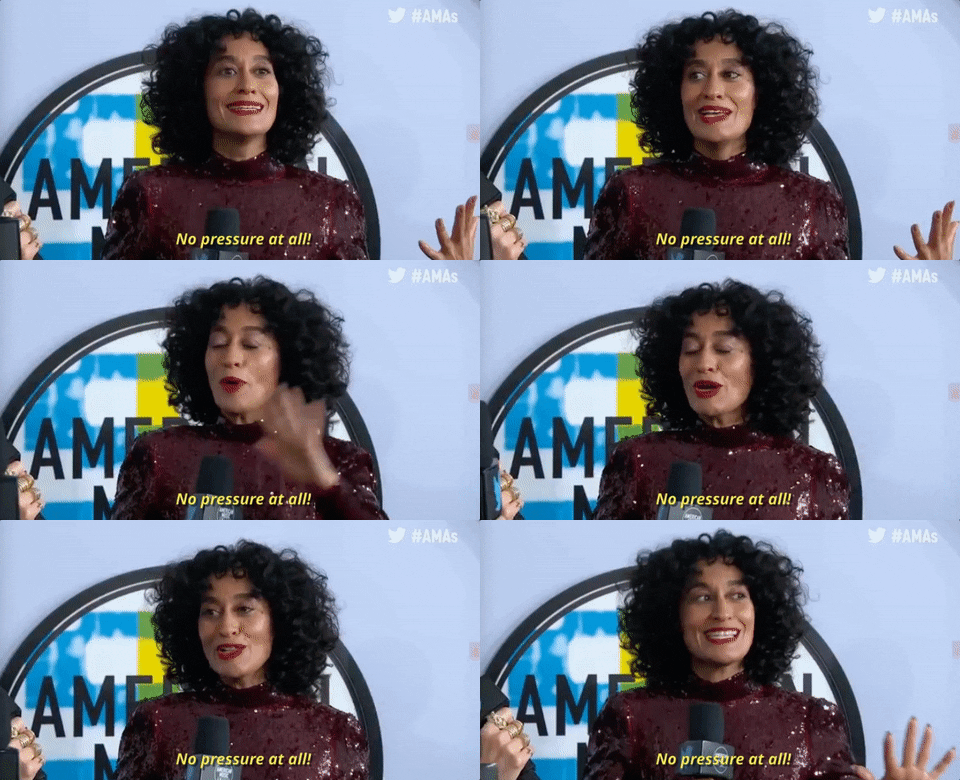
Of course, it’s always cool for you to invite them to take the diet journey with you. But preface it with “no pressure,” and if they say “no, thanks,” then leave it at that. Pushing them could cause a major crack in your relationship’s foundation.
And if you sense they’re being weird about your weight-loss, ask them about it.
If your partner has begun to buy more junk food than normal or is being pushy about to sharing a dessert with them when out to eat, ask them why they’re not being respectful of your new lifestyle.
This could easily be symbolic of a larger issue.

Don’t accuse them of trying to thwart your weight goals. But softly ask, “are you uncomfortable by me losing/gaining weight?”
Again, this goes back to keeping an open line of communication. If you two can chat about your emotions surrounding your diet, then all will be well. Ask him to respect your wishes, and come to a compromise about what foods to have in the house, when and where to eat, etc.
You two can get through this transition period. We know you can.
And if it turns out that your partner really can’t get over your new body, then perhaps they are not the right partner for you.